Preparedness, By the Official Numbers
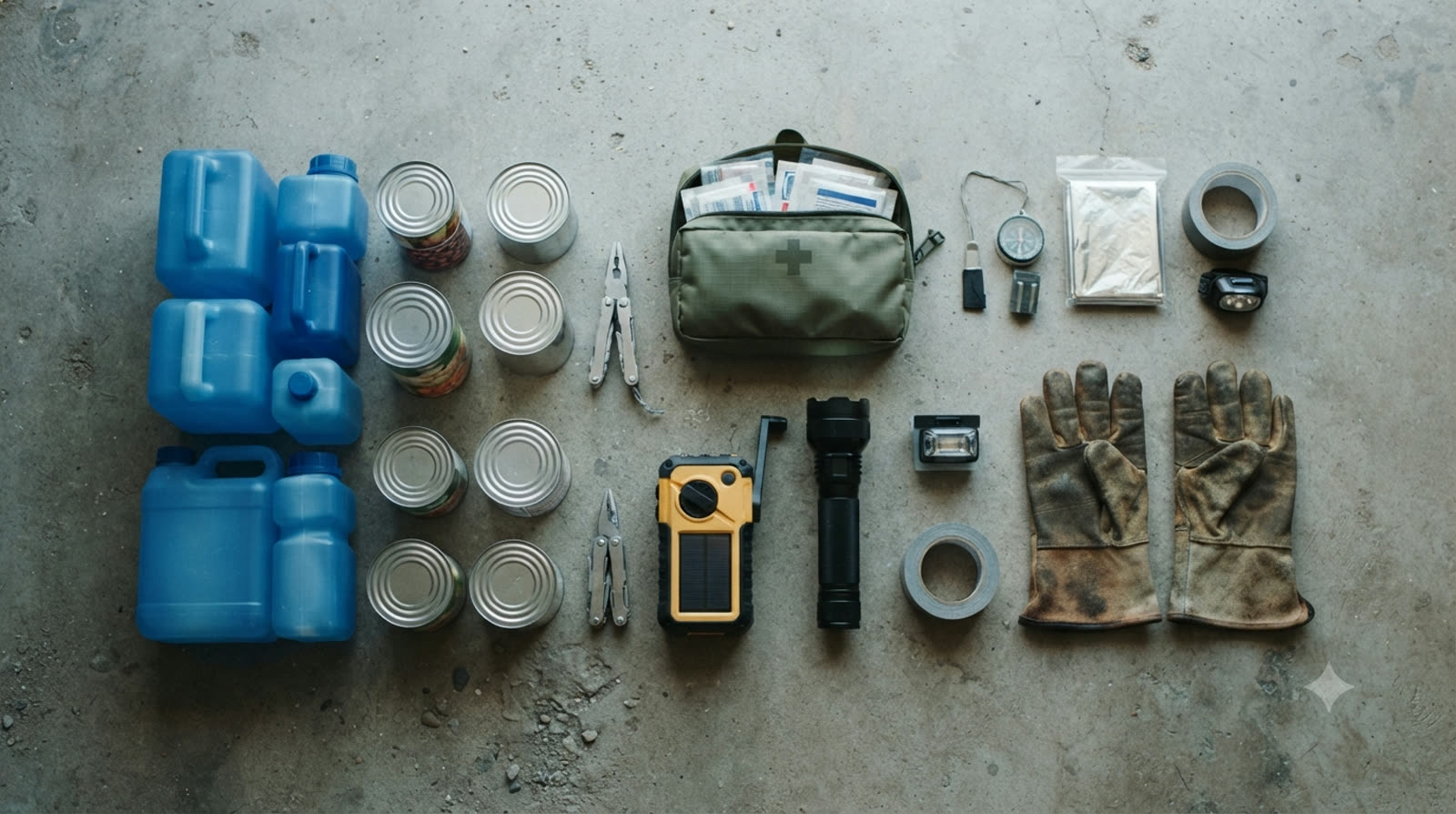
Ready Lab exists because most "prepper" content is either fearmongering or vague. We stick to the published FEMA / Ready.gov, American Red Cross, CDC, and NOAA numbers — 1 gallon of water per person per day, 8 drops of bleach per gallon, 20 feet of clearance for a generator — cite the source for every figure, and never dress up a checklist as a survival fantasy. No prices or star ratings on any pick, and every recommendation names an honest drawback.
Most emergency-prep pages either sell dread or repeat a vague "have a kit ready" line with no numbers behind it. We do the opposite: every fact on this site traces to a specific agency page, and we separate what's an official minimum (3-day water/food) from what's a stronger, still-official target (2-week water/food) so you can decide your own level of readiness without guessing.
Water: Storage & Treatment
The FEMA baseline is 1 gallon/person/day, 3-day minimum, 2-week better — plus the official 8-drops-per-gallon bleach method.
The 72-Hour Kit
What ready.gov's actual checklist puts in a basic kit, and where premade bug-out bags pad the list.
Alerts & Radio
Why NOAA SAME county-level alerting matters more than hand-crank vs. battery.
Generator & Power Safety
The CDC's 20-foot carbon monoxide rule, and the gear that actually lets you follow it.
Food: Freeze-Dried vs. Canned
The real cost-per-calorie and shelf-life math between the two main options.
Car Emergency Kit
The most overlooked 72-hour kit — most stranded drivers are close to home, not far from it.
Start here — the first four things in the kit
Preparedness lists get long fast, and people stall before buying anything. These are the first four items from the kit on this site, water storage first because it's the one with a hard per-person-per-day figure behind it. Each links to a live Amazon search rather than a fixed listing.
WaterBrick 3.5-Gallon Stackable Container (4-Pack)
Stackable, food-grade, ~14 gal total for 4-pack, screw-cap, BPA-free
Modular stacking design fits in closets and under stairs far better than a single large drum, and each brick is light enough to carry when full.
Best for: Apartment or garage storage of the FEMA 2-week per-person water target without floor-space commitment
Watch out: At 3.5 gallons each you need 4 per person for a 2-week supply, so cost adds up fast for a family — cheaper to mix with large drums for bulk and bricks for portability.
Check price on AmazonNot deciding today? Add it to your cart over there — Amazon keeps it saved (and flags any price change) until you're ready.
Reliance Aquatainer 7-Gallon Water Container
7-gallon rigid jug, spigot, food-grade HDPE
The simplest, cheapest way to hit a meaningful chunk of the 3-day-per-person water minimum in one container with a built-in pour spigot.
Best for: Households wanting an inexpensive first water-storage container before scaling up
Watch out: Full, it's about 58 lbs and awkward to move — plan where it lives before you fill it, and rotate/clean per the label rather than leaving it sealed indefinitely.
Check price on AmazonNot deciding today? Add it to your cart over there — Amazon keeps it saved (and flags any price change) until you're ready.
Water Preserver Water Preserver Concentrate
Liquid stabilizer, treats up to 55 gallons, extends storage to 5 years per label
A pre-measured alternative to counting bleach drops, letting stored water go years between rotations instead of 6 months.
Best for: Buyers who want to store water once and not think about rotation constantly
Watch out: This is a storage stabilizer, not a substitute for boiling or a certified filter if the water source itself is questionable — read the label's exact dosing.
Check price on AmazonNot deciding today? Add it to your cart over there — Amazon keeps it saved (and flags any price change) until you're ready.
Sawyer Squeeze Water Filter
0.1 micron hollow-fiber filter, removes 99.99999% bacteria/protozoa, no batteries
A compact, no-power filter that works on questionable found water (streams, rain barrels) when your stored supply runs out.
Best for: Extending water security beyond your stored supply without electricity
Watch out: Filters remove bacteria/protozoa but not viruses or chemical contaminants — pair with boiling or purification tablets if the water source is suspect for those.
Check price on AmazonNot deciding today? Add it to your cart over there — Amazon keeps it saved (and flags any price change) until you're ready.
Start with the numbers
Class guides
How we work
We're a research-based site: every figure is drawn from ready.gov, FEMA, the American Red Cross, the CDC, or NOAA, cited by name and linked. We don't publish prices or star ratings, we always name a downside on gear picks, and we never dramatize risk to sell a product. Read our full methodology →